| Click Here for Movie Version (127Kb) |
|---|
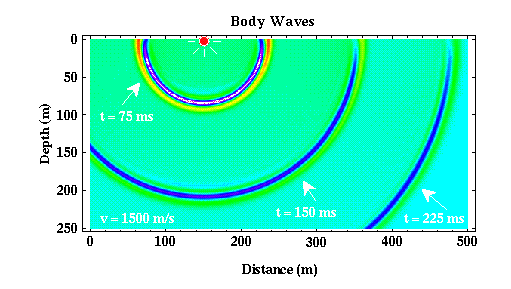
The color being plotted is proportional to the amplitude of the body wave. Light blue-green is zero amplitude, red is a large positive amplitude, and purple is a large negative amplitude. Notice that this plot is explicitly constructed in a reference frame that fixes time, thus allowing us to examine the spatial variations of the seismic wave. At any given time, notice that the wave is circular with its center located at the source. This circle is, of course, nothing more than a two-dimensional section of the spherical shape the wave has in three-dimensions.
Seismic body waves can be further subdivided into two classes of waves: P waves and S waves.
- P Waves - P waves are also called primary waves, because they propagate through the medium
faster than the other wave types.
In P waves, particles consistituting the medium are displaced in the same direction that the wave
propagates, in this case, the radial direction.
Thus, material is being extended and compressed as P waves propagate through the medium.
P waves are analogous to sound waves propagating through the air.
- S Waves - S waves are sometimes called secondary waves, because they propagate through the medium slower than P waves. In S waves, particles consistituting the medium are dispaced in a direction that is perpendicular to the direction that the wave is propagating. In this example, as the wave propagates radially, the medium is being deformed along spherical surfaces.
Most exploration seismic surveys use P waves as their primary source of information. The figure shown above could, however, represent either P or S waves depending on the speed chosen to generate the plot.
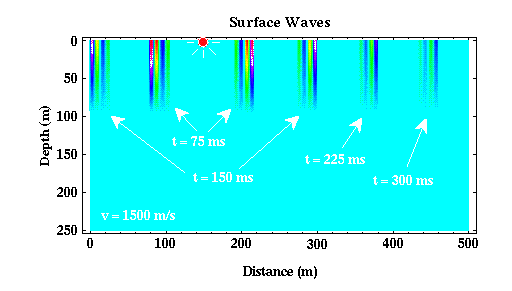
Like body waves, there are two classes of surface waves, Love and Rayleigh waves, that are distinquished by the type of particle motion they impose on the medium. For our purposes, it is not necessary to detail these differences. Suffice it to say that for virtually all exploration surveys, surface waves are a form of noise that we attempt to suppress. For reflection surveys in particular, suppression of surface wave energy becomes particularly important, because the amplitudes of surface waves generated from shallowly buried sources are often observed to be larger than the amplitudes of the body waves you are attempting to record and interpret. For refraction surveys, surface waves are less of a problem because we are only interested in the time of arrival of the first wave. Surface waves are never the first arrival. In all of the remaining discussion about seismic waves, we will consider only body waves.

