Current Flow and Ohm's Law
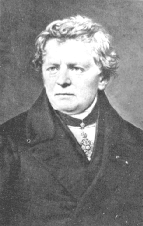 In 1827, Georg Ohm defined an
empirical relationship between the current flowing through a wire and the voltage potential required to
drive that current.* Ohm found that the current, I, was proportional to the voltage, V, for a broad class
of materials that we now refer to as ohmic materials.
The constant of proportionality is called the resistance of the material and has the units of
voltage (volts) over current (amperes), or ohms.
In 1827, Georg Ohm defined an
empirical relationship between the current flowing through a wire and the voltage potential required to
drive that current.* Ohm found that the current, I, was proportional to the voltage, V, for a broad class
of materials that we now refer to as ohmic materials.
The constant of proportionality is called the resistance of the material and has the units of
voltage (volts) over current (amperes), or ohms.
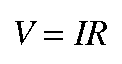
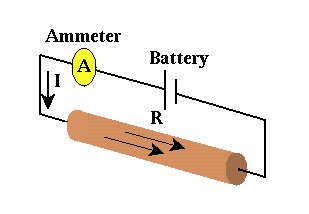
In principle, it is relatively simple to measure the resistance of a strand of wire. Connect a battery to a wire of known voltage and then measure the current flowing through the wire. The voltage divided by the current yields the resistance of the wire. In essence, this is how your multimeter measures resistance. In making this measurement, however, we must ask two crucial questions.
- How is the measured resistance related to some fundamental property of the material from which the wire is made?
- How can we apply this relatively simple experiment to determine electrical properties of earth materials?
*Ohm actually stated his law in terms of current density and electrical field. We will describe these properties later. For one-dimensional current flow in a wire, his law is given as described above.
Resistivity
- Current Flow and Ohm's Law pg 4
- The Fund. Electrical Property is Resistivity, NOT Resistance pg 5
- Resistivities for Common Earth Materialspg 6
- Current Density and Electric Fieldpg 7
- A First Estimate of Resistivitypg 8
- Current Flow From Two Closely Spaced Electrodespg 9
- A Practical Way of Measuring Resistivity pg 10
- Sources of Noise pg 11
- Depth of Current Penetration V.S. Current ElectrodeSpacing pg 12
- Current Flow in Layered Media pg 13
- Variation in Apparent Resistivity: Layered Versus Homogeneous Media pg 14
- Current Flow in Layered Media Versus Electrode Spacing pg 15
- A Second Example of Current Flow in Layered Mediapg 16